
What causes moss and algae to grow on roofs?
Moss and algae grow when roofing materials stay damp for long periods and receive limited direct sunlight. Tree shade, nearby vegetation, slow-drying roof surfaces, clogged gutters, and persistent humidity can all contribute.
In Greene, NY, changing seasons create several conditions that support biological growth. Spring rain, summer humidity, autumn leaf buildup, and winter moisture can leave parts of a roof damp repeatedly. North-facing roof slopes and sections beneath overhanging branches usually dry more slowly than open, sunlit areas.
Moss is a small plant with root-like structures that can attach to roofing surfaces. Algae are simpler organisms that often appear as dark green, gray, or black streaks. Lichen, which is a combination of a fungus and an alga, may appear as crusty or leafy patches.
These growths are not all equally damaging, but none should be ignored if they are spreading.
Is moss or algae a serious roofing problem?
Algae usually cause a cosmetic problem first, while moss can create a more direct threat to roofing materials. Dark streaks may make shingles look weathered without immediately affecting their performance. Moss, however, can hold moisture against shingles and may lift or separate their edges as it expands.
Raised shingle edges are more vulnerable to wind damage. Repeated wetting and drying can also contribute to the loss of protective granules. Once granules are missing, the underlying asphalt becomes more exposed to sunlight and weather.
Moss growth can also block water from flowing smoothly toward roof drainage areas. It may spread into valleys, around roof penetrations, or along the lower edges of shingles. These locations already receive concentrated water flow, so obstruction can increase the chance of leaks.
Growth alone does not prove that a roof must be replaced. The condition of the shingles, flashing, underlayment, ventilation, and roof structure matters more than appearance by itself.
How can residents tell the difference between moss, algae, and dirt?
Color and texture provide useful clues:
- Algae: Usually appears as flat dark streaks or broad discoloration. It may be green, gray, brown, or nearly black.
- Moss: Looks raised, soft, or tufted. It often appears along shaded roof edges or in areas where moisture collects.
- Lichen: Has a rough, crusty, or leafy appearance and may be pale green, yellowish, or gray.
- Dirt or organic debris: Usually lies loosely on the surface and can often be removed without leaving a firmly attached patch.
A roof may have more than one type of growth at the same time. Dark staining does not automatically indicate mold, rot, or a roof leak. However, staining near a chimney, vent, valley, or roof-to-wall intersection deserves closer attention because those areas can also be associated with water intrusion.
What is the safest way to remove roof moss and algae?
The safest approach is gentle treatment and limited foot traffic. Walking on a roof can damage shingles, especially when they are wet, cold, brittle, or covered with growth. It also creates a fall hazard.
Loose moss may sometimes be removed from the ground or from a properly positioned ladder using a soft brush or long-handled tool. The tool should be used in the direction of the shingle slope, not upward against the overlapping edges. Pulling upward can loosen shingles.
Avoid pressure washing. High-pressure water can remove protective granules, force water beneath shingles, and damage flashing or sealants. Aggressive scraping can cause similar problems.
Many roof-safe moss and algae treatments use diluted solutions designed to kill growth gradually. Product directions must be followed carefully because runoff can harm plants, lawns, soil, painted surfaces, and metal fixtures. Never mix cleaning chemicals, especially products containing bleach or acids.
If the roof is steep, more than one story above ground, visibly deteriorated, slippery, or difficult to access, attempting removal may create more risk than the growth itself. In those circumstances, roof access and fall protection become the primary concerns.
Can household bleach or vinegar be used?
Household remedies are not automatically safe for roofing. Strong bleach mixtures may discolor materials, damage nearby vegetation, corrode metal, or harm exterior finishes. Vinegar may have limited effect on established moss and can also affect plants and some surfaces.
The key issue is not simply whether a substance kills algae or moss. A suitable treatment must also be compatible with the specific roofing material, safe for surrounding property, and applied without damaging shingle granules.
If any cleaning solution is used, protect plants with clean water before and after treatment, control runoff, and avoid application before heavy rain. Local drainage patterns should be considered, particularly where roof runoff enters garden beds, lawn areas, or collection systems.
How can moss and algae growth be prevented?
Prevention focuses on keeping the roof cleaner, drier, and better exposed to sunlight.
Practical steps include:
- Trim branches that create dense shade or repeatedly brush against the roof.
- Remove leaves, twigs, and other organic debris before they remain wet for extended periods.
- Keep gutters and downspouts clear so roof runoff can drain properly.
- Check whether downspouts discharge water too close to the foundation or roof edges.
- Keep attic ventilation unobstructed so heat and moisture can escape.
- Watch for areas where water stands, flows slowly, or repeatedly spills from an upper roof section.
- Avoid storing materials or allowing vegetation to rest directly against roof surfaces.
- Inspect shaded roof slopes more frequently than sunny slopes.
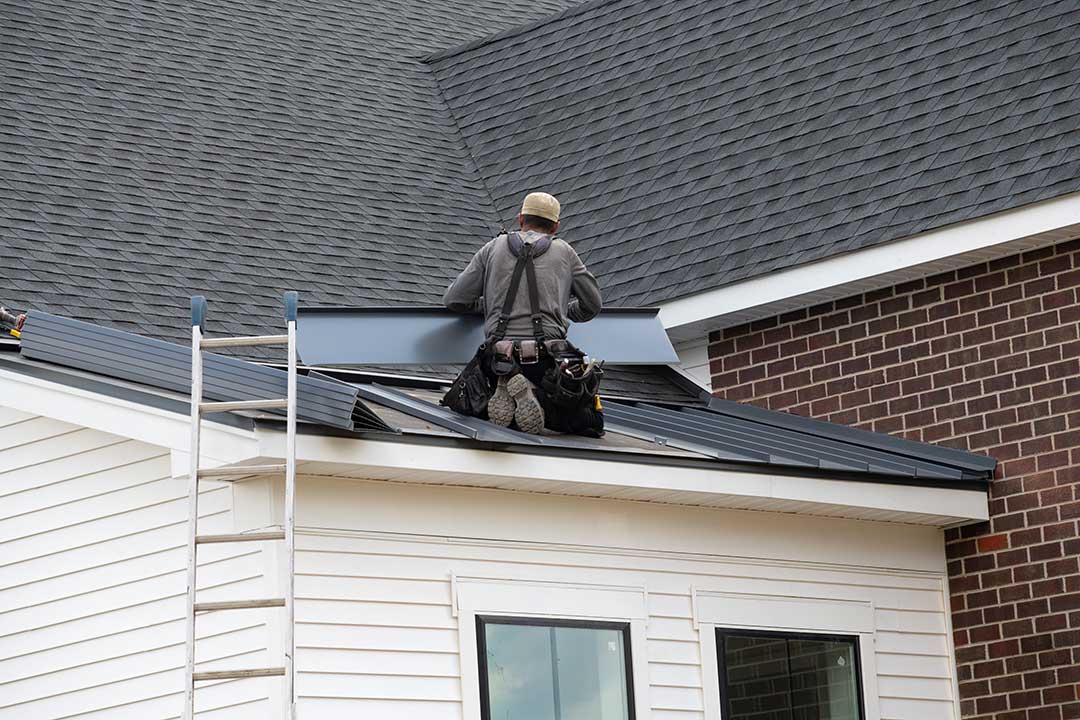
Metal strips near the upper portion of a roof are sometimes used to limit future growth as rainwater moves across the metal. These strips are not a cure for existing moss, and they work only where rainwater can reach the affected area. Installation also requires care around fasteners, flashing, and shingle edges.
Does attic ventilation prevent roof growth?
Proper attic ventilation can help reduce indoor moisture and excessive roof-deck temperatures, but it does not prevent moss or algae by itself. Most exterior growth is driven by surface conditions such as shade, rain, debris, and slow drying.
Ventilation becomes more relevant when a roof has condensation problems, damp insulation, frost buildup, or signs of moisture inside the attic. Blocked soffit vents, poorly placed exhaust vents, and bathroom or kitchen exhaust that releases into the attic can all contribute to interior moisture problems.
A roof can have good ventilation and still develop algae on a shaded slope. Conversely, a clean-looking roof can still have an attic moisture issue that requires attention.
When does roof growth suggest a larger problem?
Moss or algae deserves closer evaluation when it appears with:
- Missing, cracked, curled, or lifted shingles
- Exposed underlayment or roof decking
- Water stains in the attic or upper ceilings
- Damp insulation or musty attic odors
- Rusted flashing or deteriorated sealant
- Blocked valleys, gutters, or downspouts
- Sagging roof areas
- Granules collecting heavily in gutters
- Growth returning quickly after cleaning
Fast regrowth may indicate persistent shade, poor drainage, trapped debris, or a surface that remains damp for too long. Cleaning without correcting those conditions often produces only a temporary improvement.
Roof work becomes a safety issue when surfaces are steep, wet, icy, fragile, or difficult to reach. Fall protection, ladder placement, chemical handling, and protection of nearby landscaping all matter. In Greene, NY, seasonal weather can make roof access particularly unpredictable during spring rain, autumn leaf season, and freeze-thaw conditions.
A careful inspection should distinguish between a surface-cleaning issue and evidence that roofing materials or drainage components are beginning to fail. That distinction helps prevent unnecessary replacement while avoiding delays when moisture damage is present.
