

Roof cleaning is usually a maintenance task, not a reason to climb onto a roof without preparation. For many homes in Greene, NY, seasonal moisture, falling leaves, shaded roof sections, snow, and repeated freeze-thaw cycles can leave behind algae, moss, lichen, and organic debris. Cleaning can improve drainage and help reveal roof problems, but the method matters as much as the result.
Is it safe to clean a roof yourself?
The safest approach for most homeowners is to work from the ground or from a properly positioned ladder rather than walking across the roof. Wet shingles, moss, frost, loose granules, and sloped surfaces can make a roof far more slippery than it appears.
Do not climb onto the roof if it is:
- Wet, icy, frosted, or covered with snow
- Steep enough that balance is difficult
- Damaged, sagging, cracked, or visibly soft
- Covered with heavy moss or loose material
- Near power lines
- Equipped with skylights or roof openings that are difficult to see
- Accessible only by leaning an unsecured ladder
A fall from even a one-story roof can cause serious injury. If cleaning requires walking on the roof, using fall-protection equipment, or working near an unstable surface, the task is no longer a routine household cleaning project.
What should be removed from a roof?
Roof cleaning commonly involves four different types of material:
Leaves and twigs can collect in valleys, behind chimneys, around roof edges, and near plumbing vents. They hold moisture against the roofing and may block water from reaching the gutters.
Algae often appears as dark streaks or broad discoloration. It may be unattractive without immediately damaging the shingles, but persistent moisture and organic growth can contribute to faster aging.
Moss forms raised green patches or mats. Unlike surface staining, moss can lift shingle edges, retain water, and interfere with proper drainage.
Lichen has a crusty or branching appearance and may attach firmly to the roofing surface. Scraping it aggressively can remove protective granules along with the growth.
Identifying the material first helps determine the least damaging cleaning method. Dark streaks should not automatically be treated as dirt, and green growth should not automatically be pressure-washed away.
How can a roof be cleaned from the ground?
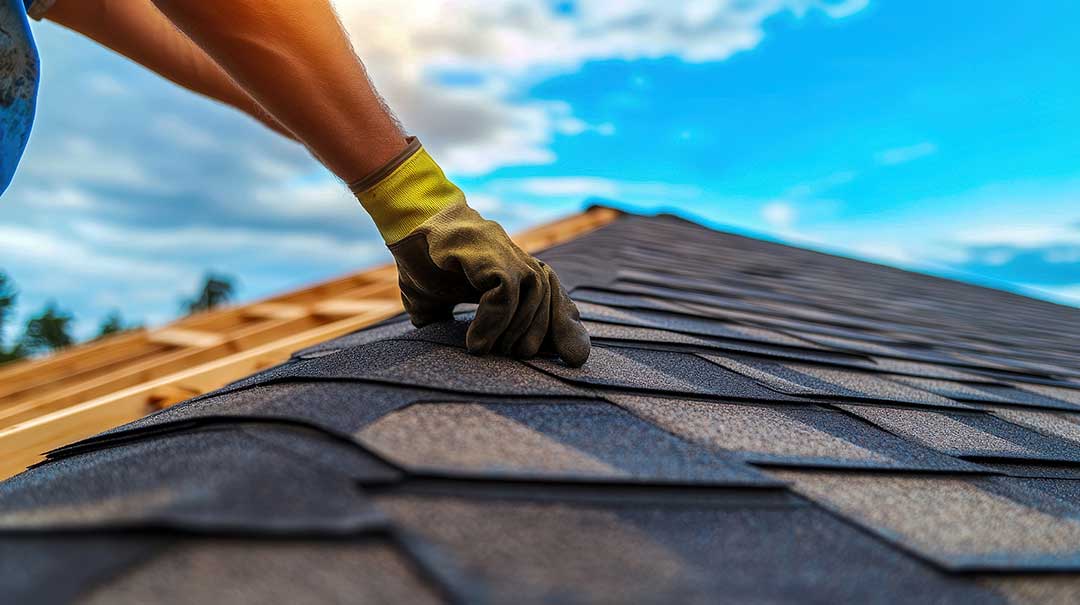
For light debris, a ground-based approach is often sufficient. Use a telescoping roof rake or soft-bristled roof brush designed for the type of roofing installed. Work from the roof edge upward only as far as the tool can reach safely. Avoid pulling downward against shingle edges, which can loosen or break them.
A garden hose may help rinse away loose dirt after dry debris has been removed. Use low water pressure and direct water downward, following the natural slope of the roof. Water forced under shingles can reach the roof deck, insulation, or interior ceilings.
Keep people, pets, vehicles, and outdoor furniture away from the area below. Wet leaves and cleaning solution can fall unexpectedly, and loose granules may make walkways slippery.
Should a pressure washer be used on shingles?
Pressure washing is generally a poor choice for asphalt shingles and many other residential roofing materials. A pressure washer can strip away protective granules, damage the shingle surface, loosen flashing, force water beneath roofing materials, and shorten the roof’s service life.
The same concern applies to aggressive brushing and scraping. Moss may be attached to the granules, so trying to remove every visible trace immediately can cause more damage than the growth itself.
A low-pressure application of an appropriate roof-cleaning solution is less abrasive than pressure washing. Even then, the solution should be tested carefully, applied according to its label, and rinsed in a way that does not send concentrated runoff into gardens, ponds, storm drains, or neighboring property.
What cleaning solution is safe for a roof?
There is no single solution that is safe for every roof. The correct product depends on the roofing material, the type of growth, nearby plants, and the manufacturer’s care instructions.
Avoid mixing cleaning chemicals. In particular, bleach should never be combined with ammonia, acids, or other household cleaners because dangerous gases can form.
Before applying any treatment:
- Read the product label completely.
- Protect or pre-wet nearby plants when the label permits.
- Cover sensitive outdoor items that could be damaged by runoff.
- Wear eye protection, gloves, long sleeves, and slip-resistant footwear.
- Use only the recommended concentration.
- Keep the solution away from siding, unfinished wood, metal surfaces, and painted areas unless the label says it is suitable.
- Rinse plants and surfaces afterward if the product directions require it.
A cleaning solution may kill algae or moss without making the roof look immediately clean. Dead growth can take time to weather away. Scrubbing it off too soon may damage the roofing.
What ladder precautions matter most?
A ladder should stand on firm, level ground and be inspected before use. It should not rest on loose soil, wet grass, ice, stacked blocks, or unstable landscaping.
For a leaning extension ladder:
- Set it at a safe angle rather than placing it nearly vertical.
- Secure the ladder so it cannot slide or shift.
- Extend the side rails above the roof edge when the ladder is being used for roof access.
- Face the ladder while climbing.
- Maintain three points of contact.
- Keep tools in a belt or raise them separately instead of carrying bulky objects while climbing.
- Do not stand on the top step or top cap of a stepladder.
- Do not overreach; climb down and reposition the ladder.
Never place a ladder where a door, vehicle, child, or pet could move it. A second person should remain nearby when ladder work is unavoidable.
When should roof cleaning be postponed?
Weather conditions matter in a seasonal community such as Greene. Choose a dry, calm day after the roof has fully dried. Avoid cleaning before rain if runoff could carry chemicals across planted areas or into drainage routes. Do not work during high winds, thunderstorms, freezing temperatures, or periods when overnight ice is likely.
Spring cleaning may reveal winter damage, while autumn cleaning can help remove leaves before repeated rain and freezing temperatures. However, clearing debris should not be used as a substitute for checking damaged flashing, missing shingles, blocked gutters, or areas where water repeatedly collects.
What roof problems should not be cleaned away?
Cleaning cannot correct structural or installation problems. Stop and reassess if you notice:
- Missing, curled, cracked, or badly lifted shingles
- Exposed underlayment or roof deck
- Rusted or separated flashing
- Sagging areas
- Water stains on ceilings or upper walls
- Large moss mats lifting shingle edges
- Granules collecting heavily in gutters
- A damaged skylight or roof vent
- Evidence of animals entering beneath the roofing
Walking on a damaged roof can worsen the problem. Roofs with significant growth, steep slopes, fragile materials, or hidden openings may require specialized equipment and training rather than ordinary household tools.
How often should a roof be cleaned?
There is no universal schedule. Inspect the roof from the ground at least twice a year and after major storms. Clean only when debris or growth is present, using the least aggressive method that addresses the problem.
Keeping nearby tree branches trimmed, maintaining clear gutters, improving shaded-area drainage, and removing leaves before they become saturated can reduce recurring buildup. These steps are especially useful where seasonal wind, snow, and damp conditions repeatedly place organic material on the roof.
IMAGE_ALT:
A homeowner uses a soft roof brush from a secured ladder while rinsing leaves from residential shingles.
